Physarum Polycephalum
Video installation
2023
The project originates from an encounter with Physarum Polycephalum, a unicellular organism characterised by a pronounced form of delocalized intelligence. It is a mucilaginous slime: it has neither a brain nor a nervous system, yet it is capable of computational calculations, making decisions, retaining memory of its actions, and finding its way out of a maze by choosing the shortest path.
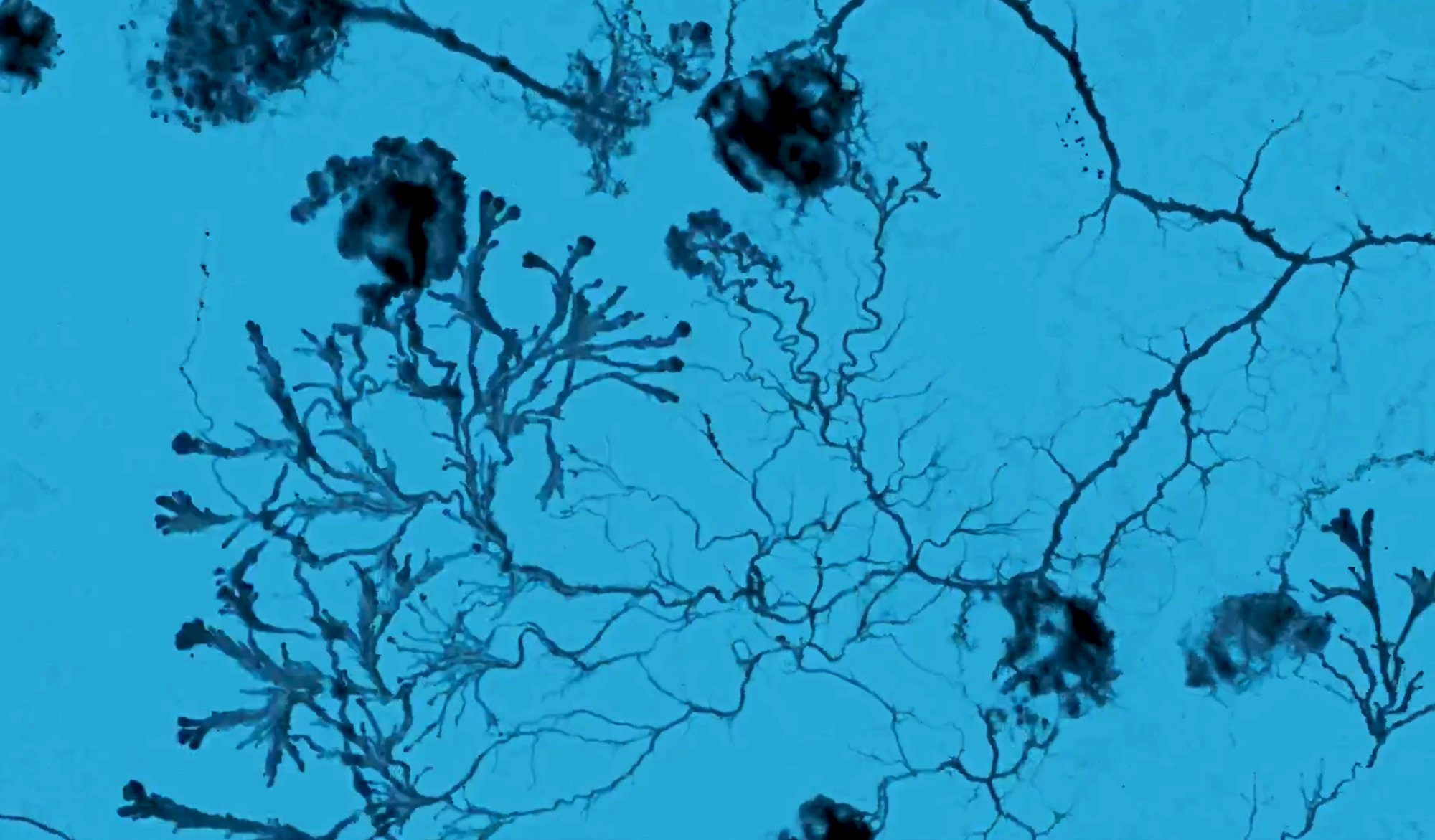
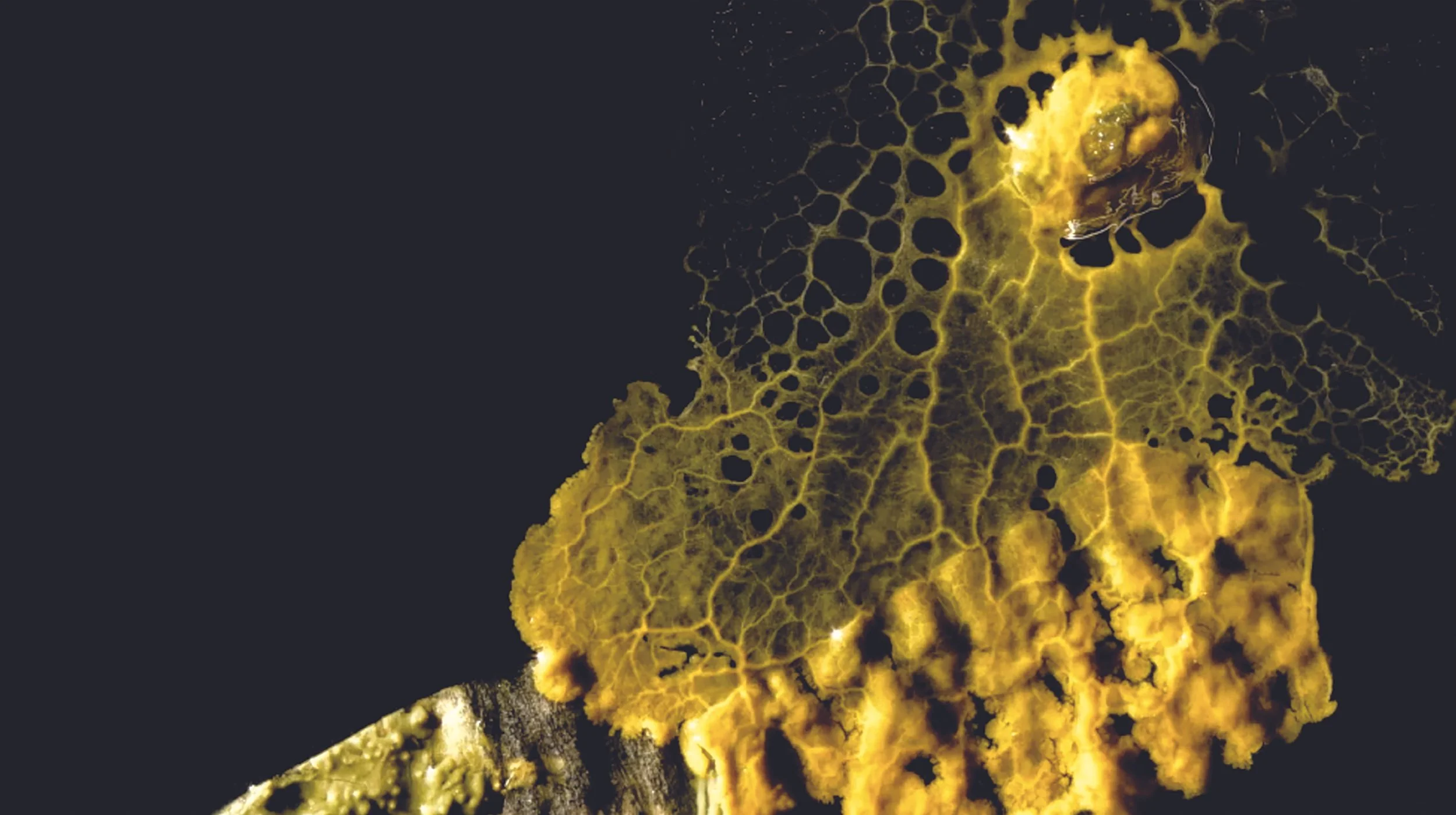
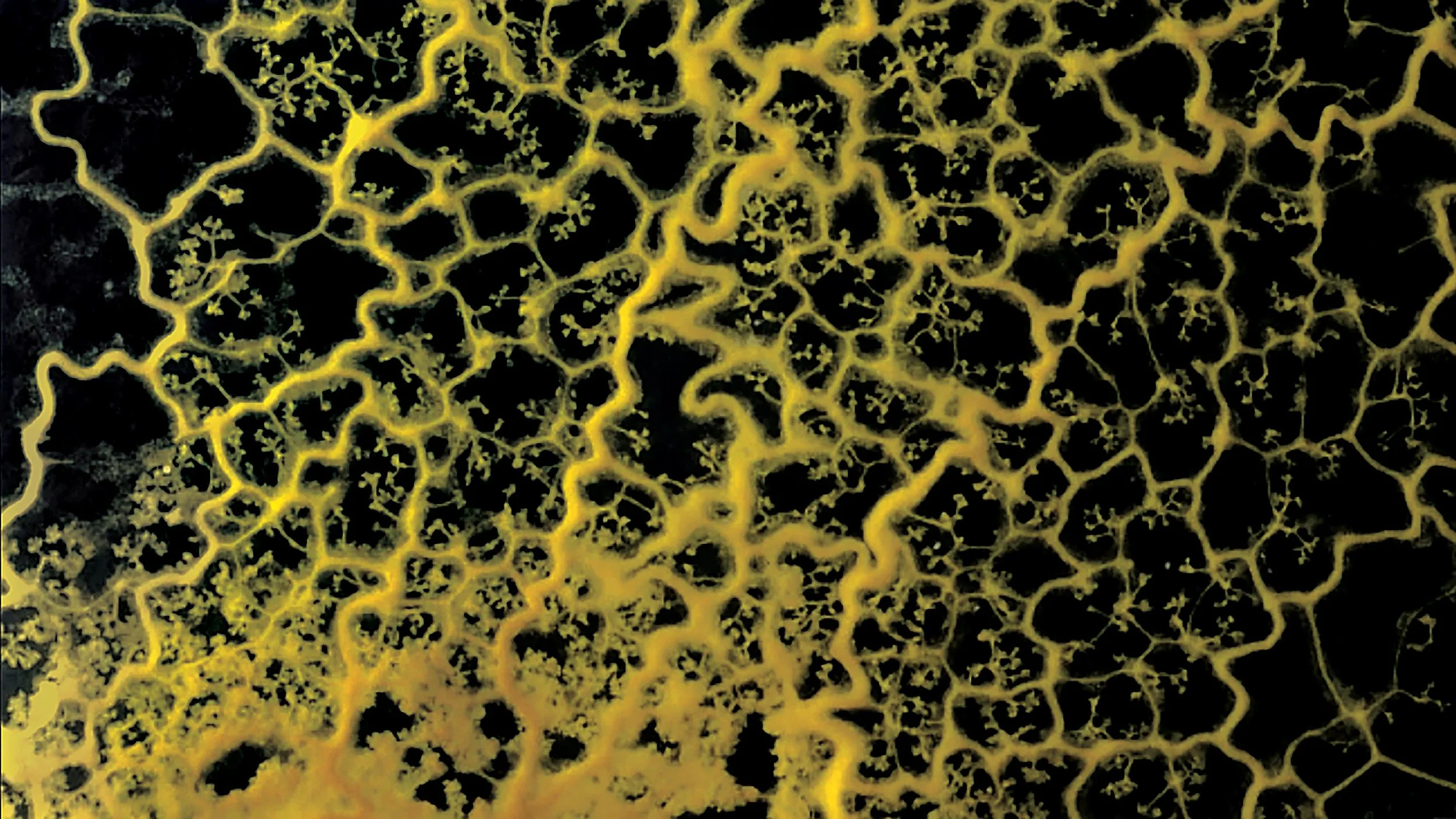
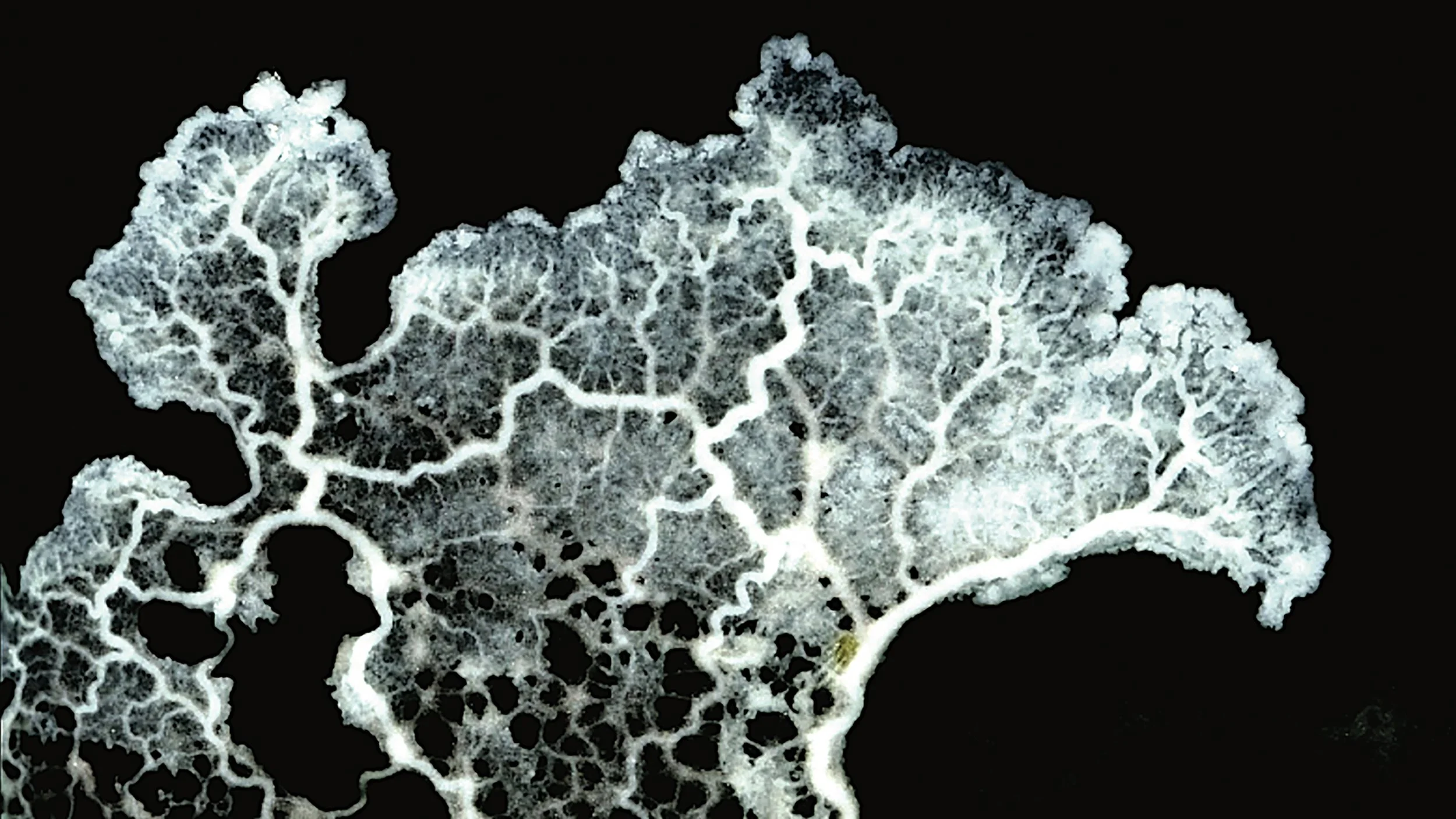
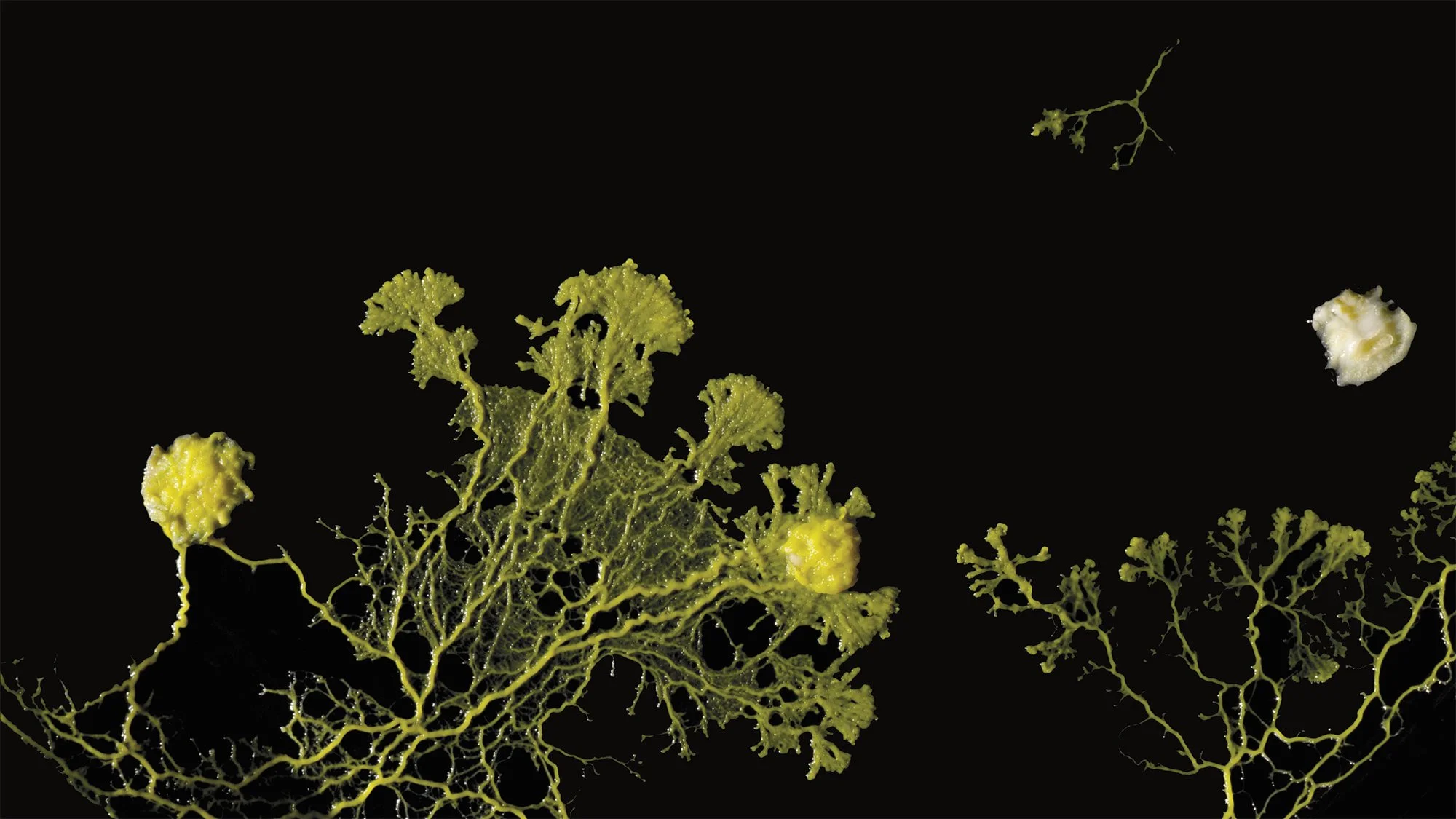
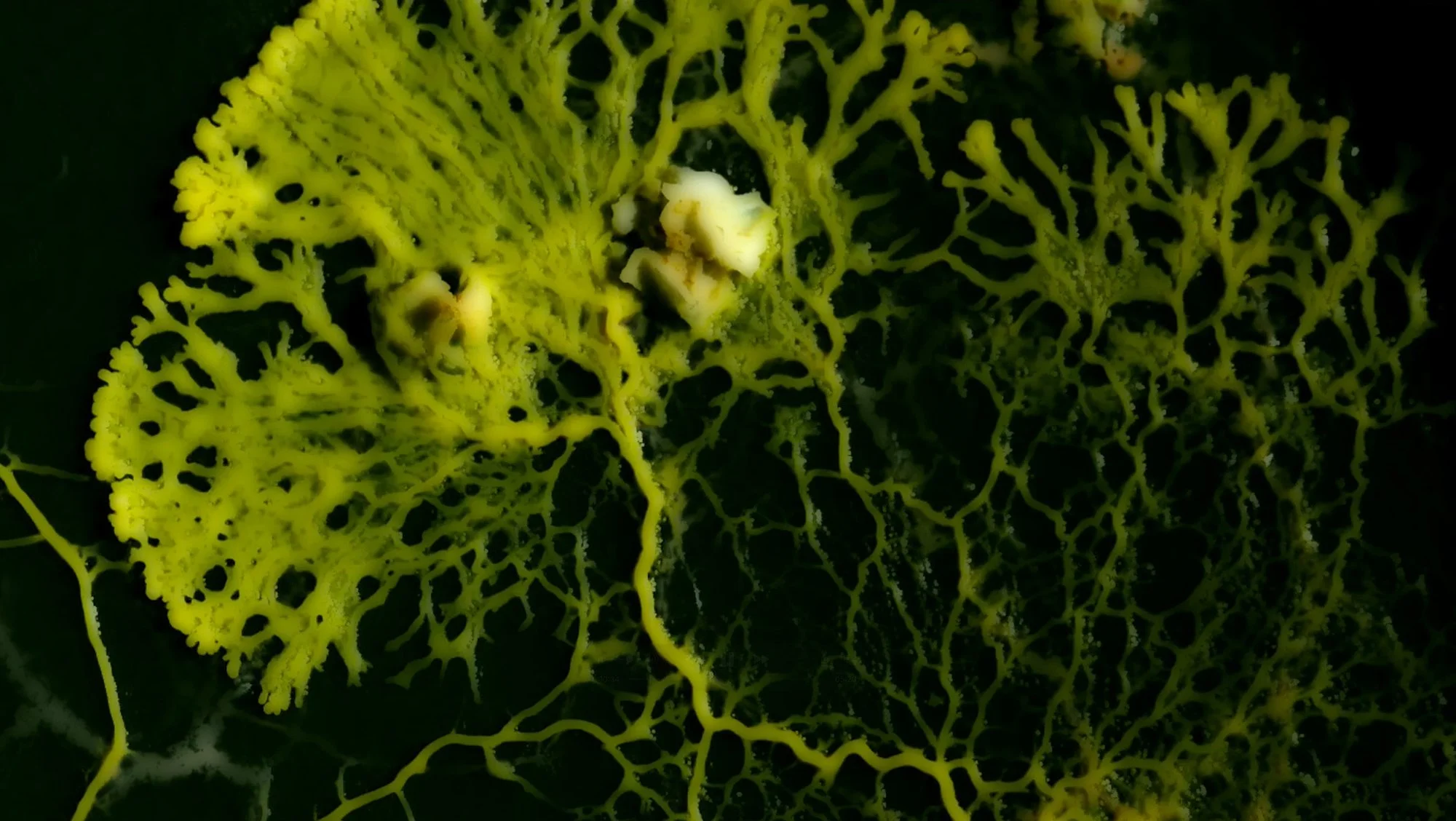
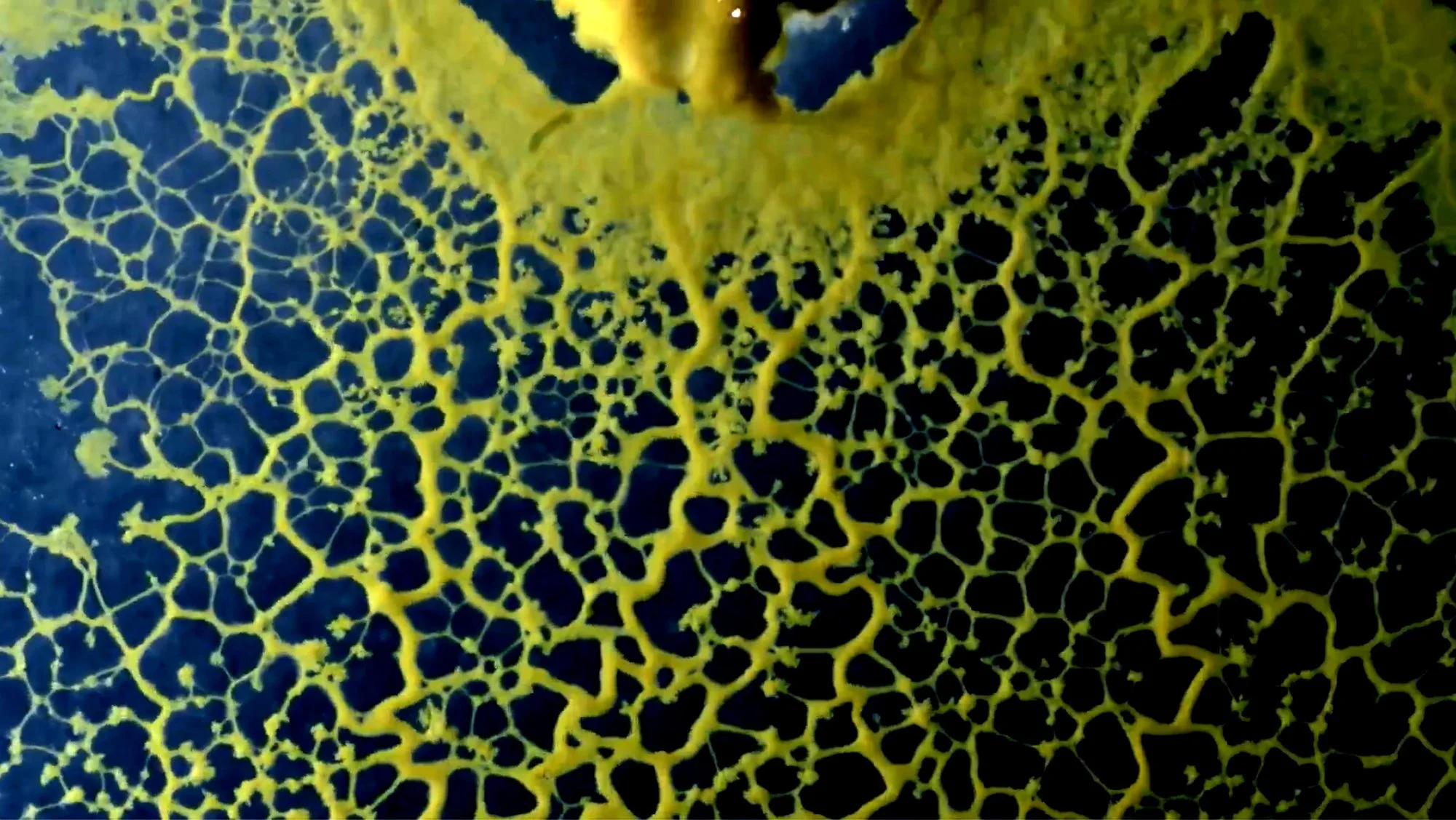
Physarum can surprisingly optimise space: in a short time, it builds highly efficient pathways and connections, comparable to those designed by engineers and computer scientists after years of study. This was demonstrated, for example, in an experiment in which its network of connections was analogous to the Tokyo railway system.
Through “shuttle streaming”, the slime draws reticular structures that return to us a fractal and interconnected vision of reality. The algorithm of its protoplasmic branching has also been associated with the structure of the so-called Cosmic Web that connects galaxies, gas, and dark matter. The delocalized and rhizomatic intelligence of matter, organic and inorganic, constantly weaves relationships from which new possibilities emerge.
The Physarum Polycephalum project is situated within this context, translating the protist’s behaviors into visual structures and sonic suggestions.
Working Process
The first phase is an actual cultivation.
The slime is grown in a humid environment, almost entirely devoid of light, and fed with oat flakes for approximately three months. The growth surface becomes its “territory”. The Physarum moves through the available space to reach food and, in doing so, expands.
With every movement, the organism develops a network of filaments. The reticular structures, generated by the way the slime searches for nourishment and optimises its paths, constitute the starting material of the work.
From the Laboratory to Images: the Time-Lapse
Physarum Polycephalum, video excerpt, 2023
To make this slow process visible, a Nikon camera captures one frame every 15 seconds. This sequence continues for weeks, accompanying the growth and movements of the Physarum inside the Petri dish.
All the frames are then assembled into a time-lapse video. The acceleration highlights what would be almost imperceptible to the naked eye: micro expansions, withdrawals and changes in direction. The Physarum is seen “embroidering” space through its plasmodial network, constantly creating new connections.
By observing its behaviors we move back in time by roughly five hundred million years, all the way to the beginnings of unicellular life on Earth.
The editing and soundtrack, curated by the artist, guide the viewer through this process, enhancing their perception and transforming the viewing into an immersive experience.
From biology to cartography
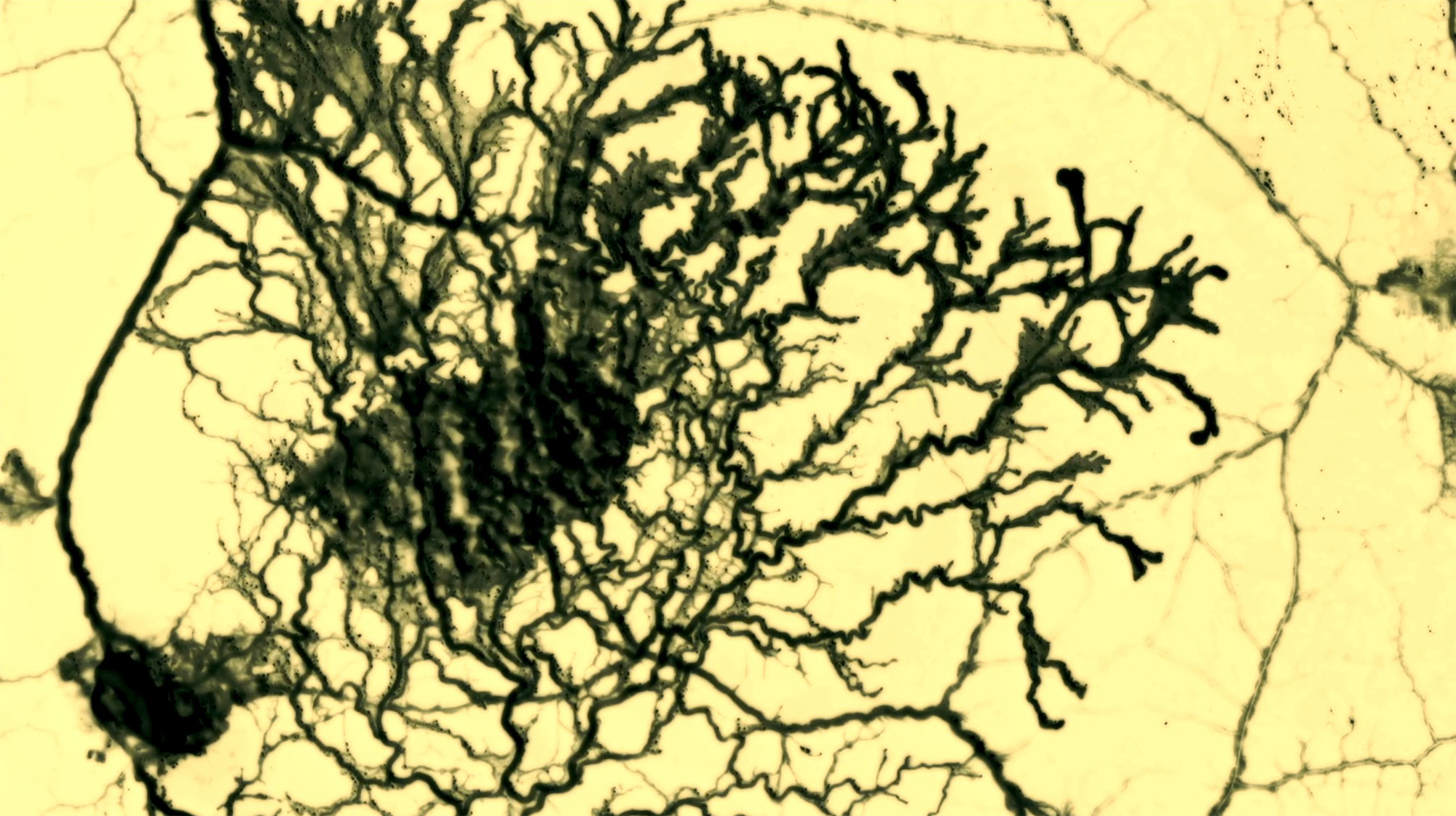
Starting from the material produced, photographs and drawings are created.
In some cases, the Physarum’s reticular structures are visually correlated with cartographic surveys of urban agglomerations. This comparison reveals a formal similarity between the organic patterns of slime and the networks of streets and infrastructure designed by humans. In other images, the branching recalls vegetal sections or cosmic maps.
The aim is to show how the same type of reticular structure can appear on different scales, both microscopic and macroscopic.
The Video Installation
The Physarum Polycephalum video installation translates this work into an exhibition format, enlarging the patterns generated by the organism to an environmental scale until they become an abstract landscape occupying the wall.
The viewer witnesses a series of transformations that merge and recombine according to logics that reproduce order and efficiency.
Distributed Intelligence
and Self-Organisation
The project aligns with research on “soft materials”, exploring new technologies, even at the nanometric scale, based on the principle of self-organisation in complex systems. Physarum polycephalum is a concrete example of distributed intelligence, a form of embodied cognition capable of making decisions without a central control system.
The biological complexity of the slime mold challenges our certainties and belief systems, offering a shift from hierarchical view of reality to a horizontal and relational model grounded in cooperation and interdependence, where the distinction between part and whole blurs.
By interpreting existence as a continuous flow of mutually related elements, the work invites reflection on another kind of intelligence, capable of organization, efficiency, problem solving, memory and spatial relationships.
Physarum Polycephalum, ink drawings
Exhibitions
The Physarum Polycephalum video installation was presented for the first time as part of the exhibition Ricamando il caos at the Hendrik Christian Andersen Museum in Rome, from 22 November 2023 to 16 February 2024.
In June 2024, the work was subsequently exhibited at the Carlo Bilotti Museum in Rome, as part of a series of meetings dedicated to the relationship between art and nature, curated by Claudio Crescentini.